Sunday, 19 February 2023

Lion's Head Meatballs (獅子頭 Shi Zi Tou)


 With the grand and exotic-sounding name, you would think the Chinese meatballs known as "Lion's Head"( 獅子頭 Shi Zi Tou ) would be troublesome to make at home. Fortunately, they are as easy as can be. A Shanghai speciality, Lions Head meatballs are made of simple, humble ingredients.

You will find quite a few versions of Lion's Head in China. One popular rendition in northern China is braised meatballs, which are braised in a soy-sauce-based liquid after browning. Another type is meatballs cooked in chicken broth. 

What are Lion's Head Meatballs?
Lion's Head meatballs (獅子頭 Shi Zi Tou) are large pork meatballs that steamed/braised and served with vegetables. Their name derives from their shape, which resembles the head of a Chinese guardian lion, or foo dog. It can be eaten anytime of the year, but is often served as a celebration dish!

Ingredients:
  • 450g ground pork/chicken
  • 10g ginger, minced
  • 1 spring onions, finely chopped
  • 1 large eggs
  • 3 tbsp plain breadcrumbs
  • 1 tbsp Shaoxing wine
  • 1 tbsp light soy sauce
  • 1 tbsp oyster sauce
  •  ½ tsp white pepper
  • ¼ five spice powder
  • 1½ tsp corn flour
  • ¼ cup water
  • 100g water chestnuts
For the sauce:
  • 1 tbsp cooking oil
  • 4 slices ginger
  • 2 spring onions, cut into 2 inch lengths (separate the white and green)
  • 2½ tsp brown sugar
  • 1 tbsp Shaoxing wine
  • 1½ tbsp light soy sauce
  • ¼ tsp dark soy sauce
  • 1 tbsp oyster sauce
  • 1½ cups water
  • 1 tsp corn flour, mixed with 1 tbsp water
  • ¼ tsp sesame oil
  • bok choy for serving
Method:

For the meatballs: Put the ground pork/chicken in a large bowl. Add the minced ginger and spring onions, egg, breadcrumbs, Shaoxing wine, light soy sauce, oyster sauce, white pepper, five spice powder, corn flour and water.  Whip everything in one direction for about 10 minutes, until the meat mixture resembles a paste. This step is important to making sure the meatballs have the right texture and don't fall apart during frying.

Finely minced the water chestnuts and add to the meat mixture and continue to mix everything together for further 5 minutes. Use a spatula to scrape everything together.

Heat enough oil to submerge the meatballs in a small, deep pot (small pot requires less oil) to about 175ºC. Make sure there are enough oil to cook the meatballs evenly.

With oiled hand, divide the meat mixture into 8-9 equal portions and shape each into a ball. Carefully lower the meatballs one at a time into the heated oil, and fry in batches until the meatballs are evenly golden brown. Remove the par-cooked meatballs with slotted spoon and set aside.

For the sauce: Heat 1 tbsp oil in a wok over low heat. Add the ginger and white parts of the spring onions and cook for 1 minute. Then add the sugar and cook until dissolved.

Add 1 tbsp Shaoxing wine, 1½ tbsp light soy sauce, ¼ tsp dark soy sauce, 1 tbsp oyster sauce and 1½ cup water. Stir and bring the liquid to a boil.

Once boiling, add the fried meatballs. Cover and cook for about 15 minutes over medium/low heat, flipping the meatballs halfway through.

After simmering, there should be about ¾ cup liquid left. Remove the meatballs from the liquid and arrange on your serving plate. I served mine with blanched baby bok choy. Just add 1 tsp oil to boiling water for the shinny look, and blanched for 30 seconds.

Mix your corn flour mixture, and pour into the sauce to thicken. Once it is thick enough to coat the back of a spoon, stir in ¼ tsp sesame oil and the green part of the spring onions. Once the spring onions are wilted, drizzle the sauce over the meatballs.

Sunday, 29 January 2023

Bunny Red Bean Bao Buns


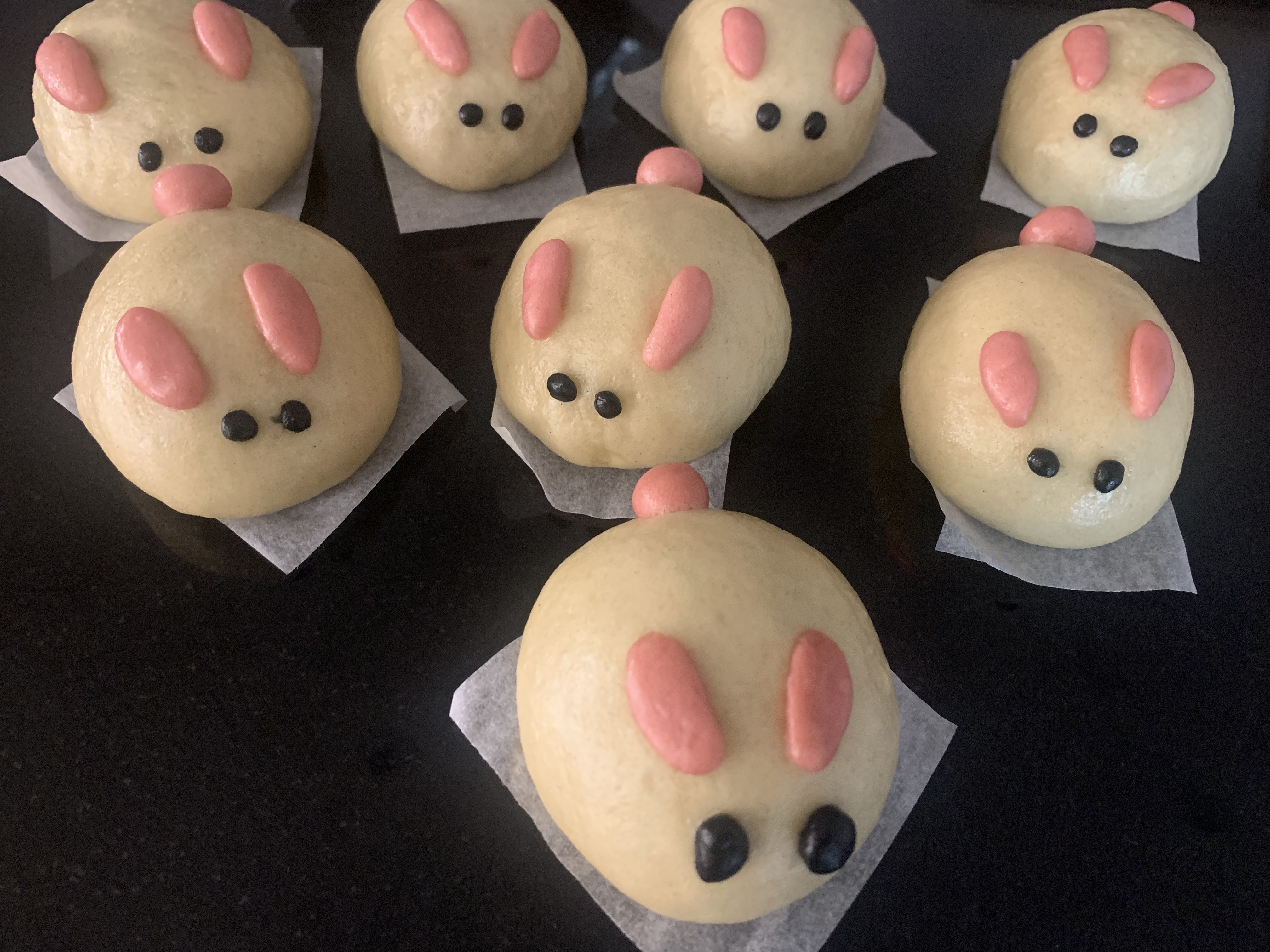
To usher the Year of the Rabbit, I decided to make my bao buns in the shape of a bunny! Bunny Bao Buns!! These vegan bunny-shaped boa buns are ridiculously fluffy, soft, shinny and sooooooo cute.


The dough can be all be mixed into one bowl which is the best. And great news is no hand muscles needed to make this delicious bao buns, all just mix in a cake mixer. 
If you want to make a plain boa buns, you can go ahead and divide and shape the dough into a ball, let it rest and then steam. However, if you want to make a bunny shaped like this, have pink and black good colouring on hand!
You only need a little dough for the pink and black details. I then divided the remaining dough for 30g each balls. Once I had all my dough separated out, I lightly covered them with a tea towel to avoid them from drying out while I shaped each bunny.
You can make it a plain buns. I like mine filled with shop bough red beans paste. You can find the paste in any Asian shop.

 For the ingredients and method on how to make the buns but not shaping, following the link below:


To assemble the bunny:

To make the bunny ear and eyes, once the dough is all ready mixed, pinch about 25g for the plain dough and add the pink colouring to the dough and mix well. 

Again take about 10g of another plain dough and add the black colouring and mix well. Set aside separately both the pink and black dough and cover with a cling film to avoid dryness.

Put the packet of the red bean paste in freezer for about 4 hours. This will make the paste much easier to handle. Then take about 15g to 20g and shape them into balls. You can also freeze the red bean balls for easy handling.

You should get about 14-15 plain dough balls. Flatten and shaped the balls into circles, with the outer edge thinner than the centre.

Place the red bean ball in the centre and encase the filling with the dough. Press and seal the dough well. Slightly elongate the bun into an oval-egg shape. Place seam-side down into a piece of baking paper.

Create a pea-sized pink ball, about 14-15 pink balls for the tail, another pea-sized of 14-15 pink dough for the ears (divide the dough into 2 to make a pair of ear) and a buckwheat-sized black dough balls for the pair of eyes. Adhere all pieces with a touch of water.

Allow to rise, covered, for 30 minutes.

Steam in a bamboo steamer for 10 minutes, and serve immediately.

Any leftovers can be stored in the fridge for 5 days, or frozen for 2 months.

Bunny shape Pineapple Tart


Why are Pineapple Tarts used in Chinese New Year?
Serving any kind of sweet dessert is encouraging during Chinese New Year because it symbolises bringing a sweet life into the new year. The Hokkiens also consider certain fruits auspicious, and they are particularly fond of pineapple, ong lai in Hokkien dialect,which literally means " fortune come".

What are Pineapple Tarts?
Pineapple tarts are addictive bite-sized buttery goodies filled with pineapple jam. Made with butter and egg yolk, melt-in-your-mouth texture which is loved by many Malaysians and Singaporeans.
Its jam is usually sweet yet tart, and often made with fresh pineapples.

Here is the link to my Pineapple Tart recipe.


Year of Rabbit Yee Sang


 Gong Xi Fa Chai!, Kiong Hee Huat Chai, Kong Hei Fatt Choy!, Selamat Tahun Baru China, Happy Chinese New Year, Xīnnián kuàilè, 新年快乐 !!!

Chinese New Year wouldn't be complete without a few key things; angpows, resplendent reunion dinner and of course, Yee Sang. Yee Sang is something that is uniquely Malaysian. 

Yee Sang, dubbed YuSheng or Prosperity Toss, is a common ritual done on Chinese New Year to signify an auspicious start to the year. Yee Sang is a type of salad that is traditionally prepared with raw fish, carrots, white radish, pickled ginger, pomelo, peanuts, sesame seeds, crackers, five spice powder, pepper, oil and plum sauce. Every ingredient represents prosperous meanings: pomelo and carrot for luck, white radish for promotion at work and fish for abundance. 

The dish is then assembled on a plate for the Prosperity Toss (lou hei) in which the vegetables are first beautifully laid on a plate, excluding peanuts, sesame seeds, crackers, powders, oil and sauce, which auspicious saying are uttered while the final ingredients are added. Then diners will toss the ingredients into the air with more auspicious wishes. This is why the dish's actual name is Lou Hei Yee Sang (捞起魚生) 

Where Did Yee Sang Come From?

Although instinctively one would assume Yee Sang comes from China, its current iteration that we all know so well was actually birthed in Malaysia itself. Legend has it that the original Yee Sang was created by Loke Ching Fatt, originally a Cantonese immigrant from China, in the 1940s who owned a small catering business called Loke Ching Kee in the sleepy town of Seremban. As Malaya was going through recovery from World War II, Loke decided to pivot his business by creating the Lo Hei Yee Sang, a dish was inspired by the Chinese celebration of Ren Ri (人日), the 7thday of the Chinese New Year, where humanity was created according to myth. As it was common for the Cantonese to eat raw fish on that day, Loke decided to create the dish we know and love today, taking some inspiration from not only Cantonese culture, but Teochew and Hokkien cultures which were prevalent in Malaya as well. The dish was also prepared intentionally ritualistic, ensuring that the flavour and colours are observed for the auspicious new year. In the past, Grass Carp (waan jyu, 鯇魚) would be used, where they would be starved for a few days to ensure all impurities are gotten rid of before slicing up for the preparation, however, today salmon would be the most common form of preparation.

Winter Pear & Ginger Trifle


Wow your guests with this delicious winter Ginger Trifle-individual desserts made with sweet and sticky ginger cake, layered with fresh pears, custard and cream. They are so simple to make and are sure to become a family favourite.
I love sweet sticky Jamaica Ginger Cake. It's a cake that he been around for over 50 years and still delicious. These individual Jamaica Ginger Cake  & Pear Trifles are really simple to make. You just need to assemble the ingredients and you have a fabulous dessert.

Ingredients:

Pear compote:
  • 4-5 fresh firm pears
  • 3 tbsp soft light brown sugar
For the trifle:
  • 500g Jamaican Ginger Cake, cut into cubes
  • 400ml double cream
  • 8-10 tbsp Cointreau orange liqueur/sherry, for non-alcoholic, use orange or pear juice
  • 500g fresh custard or shop bought
  • 5 crushed ginger biscuits
  • edible glitter & chocolate gingerbread man/Christmas tree/reindeer, optional or decoration
Method:

Pear Compote: Peel and core the pears and cut into cubes. 

Place the pear with brown sugar in a saucepan and heat, stirring until the sugar dissolves and the pears begin to give off a little liquid. Turn down to a simmer leave to cook for about 5 minutes, stirring occasionally.

Remove from heat and allow to cool completely.

Whipped Cream: Whisk the cream until it forms soft peaks. Set aside in the fridge until ready to assemble the trifles.

Assemble the trifle: Take your chosen serving dish/bowl and place a layer of ginger cake cubes in the base. Drizzle the cake layer with the liqueur or juice. 

Top with a layer of compote.

On top of this add a layer of custard.

Repeat the layers of ginger cake, liqueur/juice and pear compote.

Add a top layer of whipped cream.

Sprinkle with some crushed ginger biscuits.

Finally top with chocolate gingerbread man/Christmas tree/reindeer and a sprinkle of magical edible glitter.

Friday, 27 January 2023

Free Standing Raspberry Trifle


Looking to make a trifle with a twist and I came across this recipe from https://onlycrumbsremain.com
It looks very impressive when you sliced it like how we slice a cake!  It is less messy than the normal trifle in a large clear glass bowl.


Ingredients:

Custard:
  • 3 tbsp custard powder
  • 2 tbsp golden castor sugar
  • 450ml milk
Jelly layer:
  • 250g raspberries, fresh or frozen
  • 1 raspberry jelly
  • 4 trifle sponges
For decoration:
  • 50g milk chocolate
  • 200ml double cream
  • 1 tbsp icing sugar
  • ½ tsp vanilla extract
  • edible lustre powder glitter, optional
Method:

Custard: Line the loaf with a layer cling film. Combine 3 tablespoon custard powder and 2 tablespoon castor sugar with a little of the 450ml milk. Stir to form a smooth paste. Heat the remaining milk in a saucepan until just coming to the boil. Slowly stir the hot milk into the custard powder mixture then return to the pan. Cook over a low heat until thickened.

Allow to cool for about 10 minutes, stirring frequently to prevent a skin forming. Pour the custard into the lined tin and place in the refrigerator until completely set.

Jelly layer: Make the jelly as per the packet instructions. Arrange about 250g of raspberries in a layer over the custard. Pour over a little of the jelly and pop the tin back into the fridge until the jelly has just set. Cut the trifle sponges in half and arrange on top of the raspberries and spoon over some more jelly until the sponges just begin to float, then pop back into the refrigerator to set again. Finally pour over the remaining jelly and chill for 2 hours.

To complete: Meanwhile, make the chocolate decorations, line a tray with baking paper. Draw pencil shapes on the paper of stars or Christmas trees to use as an outline. Turn the paper over.

Break 50g chocolate into a heatproof bowl and melt over a pan of gentle simmering water. Ensure the water doesn't touch the base of the bowl. Remove the bowl from the heat. Spoon the chocolate into a small paper piping bag.

Pipe the outline of the chocolate shapes, using your pencil markings as a guide the pipe lines of chocolate back and forth to fill with a lacy effect. Ensure the chocolate lines are thick enough to prevent the shapes from breaking when they are removed from the tray. Allow to set in a cool place until required.

When the trifle is completely set. Turn out onto a serving platter.

Whisk 200ml double cream with 1 tbsp icing sugar and ½ tsp vanilla extract until just standing in soft peaks. Spoon the cream into the piping bag fitted with a star nozzle. Pipe the cream on top of the custard.

Using a small brush dust the chocolate shapes with lustre powder if desired then carefully remove from the baking paper and transfer to the trifle to decorate. For extra sparkle flick a little more lustre powder or glitter around the sides and over the top of the trifle.

Serve!!

Wednesday, 25 January 2023

Mince Pie Martini


With the Christmas season just around the corner, it's time to start feeling a little bit more merry. And what better way to help you get into the festival spirit, then with a festive cocktail!
Mince pie- in a glass! Yup you heard it right. This Christmas-tasting drink tastes and looks delicious.


Ingredients:

For the mincemeat syrup
  • 100g golden castor sugar
  • 50g mincemeat
For the garnish
  • 4 tbsp caster sugar
  • 4 tsp mixed spice
For the cocktail
  • 4 tsp mincemeat
  • 100ml gin
  • 100ml sweet red vermouth
  • 20ml dark rum
Method:

To make a mincemeat syrup, put 100ml water, the golden caster sugar and mincemeat in a pan and bring to the boil. Cool and strain though muslin into a sieve. Separately, mix the caster sugar and mixed spice, then dampen the rims of 4 martini glasses and dip in the sugar and spice mixture.

Muddle the mincemeat in a cocktail shaker, then add the gin, sweet red vermouth, dark rum, 80ml mincemeat syrup and ice. Shake well and strain into your prepared glass.

Enjoy!

Thursday, 29 December 2022

Christmas Mincemeat Loaf Cake


Mincemeat Loaf Cake, a festival dessert that is super easy to make with just a few simple ingredients. If you happen to have a some mincemeat left in a jar and a few dried fruit, you can put them to great use in this moist and flavourful cake that tastes exactly like Christmas. Perfect for this time of year when we are all so busy!

Mincemeat Loaf Cake is the best easy festival bake. If you love mince pies or want something quicker, lighter an easier than a full Christmas fruit cake with your afternoon tea, this is the perfect bake for you.

This Mincemeat Loaf Cake is like a fruit loaf, but with a deliciously Christmasy flavour to it. Or a slightly lighter version of a Christmas cake. If you have made mince pies and still have some mincemeat to use up, this is the perfect way of doing that.

Mary Berry's Mincemeat Loaf Cake is a perfect easy, one bowl bake-and it is a perfect recipe for using up that half empty jar of mincemeat. You can't go wrong with a Mary Berry recipe and this one is a real classic. A light fruit cake that's perfect with a cup of tea or a glass of mulled wine.

I make these Mincemeat Loaf Cakes every Christmas to give as gifts and they always go down really well.


  • 150g soft butter
  • 225g mincemeat
  • 150g soft light brown sugar
  • 225g self raising flour
  • 2 medium eggs
  • 100g glace cherries, optional
  • 100g sultanas, raisin or mix fruits
  • 2 tbsp milk
  • 50g blanched almonds, for decoration
Method:

Preheat oven to 180ºC/160ºC for fan assist oven.

Grease and line 2 1lb loaf tins.

Mix all the ingredients except for the blanched almonds together until they are well incorporated.

Spoon the mixture into your loaf tins. Stud with blanched almonds/halved cherries.

Bake for 45 minutes to 50 minutes or until the cakes are shrinking from the sides, risen and golden and a skewer inserted in the middle comes out clean.

You can "feed" tis cake with brandy or rum if desired-once the cakes are cool, poke little holes in the top of the cakes with a skewer and drizzle with a pastry brush over your alcohol of choice!
 

Wednesday, 28 December 2022

Turmeric Sourdough Bread


We all know how important turmeric is for our health. So what can be better than a turmeric loaf made with some sourdough starter and love. This is a simple sourdough bread and all you need to have are time and patience. It takes around a day to make (depends on the climate in your country) but it is worth it, especially since you don't need to be hands on the entire time. Just a little time here and there and you have a lovely homemade loaf ready to eat.


Ingredients:
  • 270g bread flour
  • 30g whole wheat flour
  • 207g water
  • 21g cold water added along with salt
  • 6g turmeric powder
  • 60g levain
  • 6g salt
Method:

Mix water with flour and turmeric powder, cover, let it rest 1 hour for autolyse. During the autolyse process flour absorbs water, becoming fully hydrated. This activates gluten development.

After an hour, add sourdough starter. Mix on low speed of your mixing machine for 2-3 minutes. You can also use your hand to mix the dough. Cover, let it rest for 30 minutes.

After 30 minutes up, add salt and extra water. The process of adding extra water is called bassinage, it helps to tighten up gluten. Mix on low speed of your mixing machine for 2-3 minutes, or mix well with your hand. The dough should come up together, but still be sticky on the bottom.

Continue gluten development and structure building by performing stretches and folds during the warm fermentation period. Leave to rest 30 minutes.

Spray your worktop with water, wet your hands to perform lamination. Lamination is the process of stretching the dough as thin as you can without ripping it. Spread the pumpkin seeds all over the dough, fold and let it rest for 45 minutes.

Perform 3 stretches and folds every 45 minutes. Performing stretches and folds will help with gluten development. Keep monitoring the dough, if it rises too fast, you can shorten the time between stretches to 40 minutes or less.

After the final stretch, let the dough proof for 30 minutes. You should see some bubbles on the surface, the dough has to become lighter. We are looking for 40%-5-% rise.

After 30 minutes of proofing, transfer the dough onto a worktop and dust the worktop with flour. Flip the dough over so the floured side faces down. Fold the dough onto itself so the flour on the surface remains entirely on the outside of the loaf. This will become the crust.

Place the dough round on a worktop and let it rest for 30 minutes uncovered.

Dust the dough with flour. Use a dough scraper to flip it over on to a worktop so the floured sides face down.  Starting with the side closest to you, pull the right 2 corners of the dough to the left, then fold them up into half of the dough. Repeat this action with the other sides too.

Finally, roll the dough. Shape it into a smooth, taut roll. Transfer the roll, seam side up, to a prepared proofing basket.

Cover it with plastic and let the dough rest for 15 minutes. Then transfer the dough to rise for 14-24 hours in the refrigerator.

Preheat your oven to 220ºC, place the dutch oven with lid inside for 20 minutes. Remove the dough from the fridge.

Flip it over on a baking paper, score it with a sharp knife or blade or a scoring lame. Transfer on to the dutch oven, cover with lid and bake for 15 minutes. Remove the lid  and reduce the oven temperature to 200ºC. Bake for 20 minutes until golden brown.

Enjoy!

Pear & Onion Chutney


Pear and onion chutney with a hint of heat from chili is the perfect way to spice up any Christmas leftovers. It makes the ideal accompaniment to cold meat, or you could even serve a dish of this chutney with your after-dinner cheese platter.

The word chutney is derived from a Hindi word, chatni, meaning "to lick" or "to eat with appetite". I am sure you will agree with me, once you have tasted this pear and onion chutney, that this is a most appropriate description. This pear and onion chutney is lip-smackingly good.

The sweetness of the pears and onions, combined with the tartness from the vinegar and the heat from the chili come together perfectly, providing the typical chutney blend of sweet, sour and spicy flavours.


Ingredients:
  • 225g white onions, finely chopped
  • 675g firm fresh pears, finely chopped
  • 150g sultanas
  • 60ml red wine vinegar
  • 25g dark brown sugar
  • ½ tsp chili flakes
  • 1 tbsp olive oil
Method:

Peel the pears, discard any pips and chop into 1 cm pieces. For a smoother chutney, you can grate the pears.

Peel the onions and chop into a fine dice. For a smoother chutney, whizz the onions in a food processor. Do not grate the onion as this will create too much onion juice which will give a bitter taste.

Fry the onions on a low heat in 1 tablespoon of olive oil until just starting to soften.

Add the remaining ingredients, stir well, and bring to the boil.

As soon as the chutney starts to boil, turn down the heat to a low simmer, cover the pan with a lid and leave to simmer for approximately 1 and a half hours, stirring occasionally.

The chutney will be done when it turns thick and syrupy and leaves a clean trail on the bottom of the pan when you draw a spoon through it.

If the chutney is still watery after 1 hour and 15 minutes, remove the lid for the final 15 minutes to allow it to thicken.

Pour the hot chutney into warm sterilized glass jars and seal.

Store unopened in a cool dark place for up to 6 months. Once opened, store in the refrigerator and use within 6 weeks

Nutella Chocolate Cake


This Nutella Chocolate Cake recipe is every Nutella lover's dream cake! It's a moist chocolate cake with delicious Nutella icing, all covered in chocolate ganache. Delish!


This is my go-to chocolate cake recipe because it is super soft and very chocolate-y. Perfect for birthdays and celebrations and a delight to chocaholic everywhere! I wanted a maximum icing to cake ratio, so I made four layers of cake so that I could have plenty of Nutella icing piled between them. I only have 2 8 inch pans though, so I baked two cakes at a time.

#

Ingredients:

Chocolate Cake:
  • 260g plain flour
  • 400g sugar
  • 85g unsweetened cocoa powder
  • 2 tsp baking soda
  • 1 tsp salt
  • 2 large eggs
  • 240ml (1 cup) buttermilk
  • 240ml (1cup) vegetable oil
  • 1½ tsp vanilla extract
  • 240ml (1cup) boiling water
Nutella Frosting:
  • 445g salted butter, softened
  • 180g shortening
  • 620g Nutella hazelnut spread
  • 1150g icing sugar
  • 5-6 tbsp milk
Chocolate Ganache:
  • 170g semi-sweet chocolate chips
  • 120ml double cream
  • Ferrero Rocher chocolate for decorations
Method:

Prepare four 8 inch cake tins with baking paper in the bottom and grease the sides.

Add all the dry ingredients to a large bowl and whisk together.

Add eggs, buttermilk and vegetable oil to the dry ingredients and mix well.

Add vanilla to boiling water and add to mixture. Mix well. 

Pour into four 8 inch cakes pans and bake at 150ºC for about 25 minutes, or until a skewer comes out clean. Remove cakes from oven and allow to cool for about 10 minutes, then remove to cooling racks to cool completely.

Make icing while the cakes cool. Beat together butter and shortening until smooth.

Add Nutella and mix until smooth.

Slowly add half of the icing sugar and mix until smooth.

Add 2-3 tbsp milk and mix until smooth.

Slowly add the remaining icing sugar and mix until smooth.

Add more milk until the frosting is the right consistency.

Once the cakes are cool, remove cake domes from top with a serrated knife. 

Place first layer of the cake on a plate or cake board. Add about ¾ cup of frosting and spread into an even layer.

Add second layer of cake and add another ¾ cup of frosting and spread into an even layer.

Add third layer of cake on top and add another ¾ cup of frosting and spread into an even layer.

Top frosting with fourth layer of cake, then frost the outside of the cake. 

To make the chocolate ganache, place the chocolate chips in a medium sized bowl.

Heat the double cream just until it starts to boil. Pour over the chocolate chips and let it sit for 2-3 minutes, then whisk until smooth.

Drizzle the chocolate ganache around the edge of the cake, then pour the remainder if the ganache on top of the cake and spread evenly. 

Allow the ganache to firm up a bit, then pipe the remainder of the frosting around the top edge of the cake and top each swirl with a Ferrero Rocher chocolate.


Triple Chocolate Cake


I was looking for an easy and fuss free chocolate cake that will then "dress-up" to make an impressive showstopper birthday cake for a chocolate lover. After a long search, I found this excellent recipe from thecrumbykitcen.com . 
The cake is filled with whipped chocolate ganache, fluffy homemade chocolate buttercream and top off with a few chocolate truffles, so every bite is a burst of chocolate! This cake is actually very easy to assemble and is perfect for birthdays.
The moist triple chocolate cake is so much better than a box cake mix. This cake is super fluffy and moist. It is even moist when cold!

Ingredients:
 Chocolate Cake:
  • 205g plain flour or 1½ cups
  • 300g sugar or 1½ cups
  • 75g cocoa powder or ¾ cup
  • 1½ tsp baking soda
  • 1 tsp baking powder
  • 1 tsp salt
  • 2 large eggs, room temperature
  • 1 cup butter milk, room temperature*
  • ½ cup vegetable oil
  • 2 tsp vanilla extract
  • ½ cup boiling water
Chocolate Ganache-for filling and truffles:
  • 225g dark chocolate
  • 240g double cream
  • some cocoa powder & sprinkle, for the truffles
Chocolate Butter Cream:
  • 225g butter
  • 375g icing sugar
  • 65g cocoa powder
  • 1½ tsp vanilla extract
  • ¼ cup double cream
Method:
For Chocolate cake:

Preheat the oven to 175ºC/160ºC for fan assist oven. Line three 6 inch cake pans with baking paper, set aside. 

In a large bowl, combine all the dry ingredients  and whisk until blended. With a spoon, create a well in the middle.

Add the eggs, buttermilk, oil and vanilla extract and stir until combined. Scrape down the sides of the bowl and add the boiling water. Whisk until well combined.

Divide batter evenly between the three cake pans and bake for 30-35 minutes, or until a skewer inserted comes out clean.

Allow the cakes to cool in the pans for 5 minutes, then remove to cooling rack to cool completely.

For Chocolate Ganache:

Chop the chocolate and place it in a large bowl. Set aside.

Heat the cream in a saucepan over medium-low heat until the mixture begins to steam. Do not simmer or boil.

Pour the warm cream over chopped chocolate in a bowl. Let it sit for 5 minutes, melting the chocolate slowly.

Whisk or stir the cream and chocolate together gently until it is combined into a smooth ganache. 

When ganache is cool, divide it between two bowls. Use a hand mixer fitted with a whisk attachment and whip up one bowl until it is fluffy  and thickened. Be careful not to over-whip, otherwise it will be impossible to spread.

Cover and place the second bowl of ganache in the refrigerator for at least 2 hours, until set.

Once the ganache is firm, use a small scoop to portion out 1 tablespoon sized balls. Roll them quickly between your palms until round and smooth.

Roll truffles around in  cocoa powder or sprinkles until completely coated. Transfer to a baking paper lined plate and refrigerate until ready to use.

For the Whipped Chocolate Buttercream:

Place softened butter and 100g icing sugar in a large bowl. Using a whisk attachment, mix until combined, scrape the bowl, and repeat with the remaining icing sugar, adding 100g at a time. When all icing sugar has been added, turn the speed to medium-high and whip about 5 minutes, until pale and fluffy, scraping the bowl as needed.

Add the cocoa powder and vanilla and blend on low for 1 minute. Add the double cream in a slow drizzle as it mixes.

Once the  mixture is mostly combined, turn off the mixer and scrape down the sides and bottom of the bowl.

Whip buttercream on medium-high speed for 4-5 minutes, until it is silky, light and fluffy.

To Assemble the Cake:

Using a sharp serrated knife, carefully slice any domed tops off each cooled cake layer.

Place a layer on a cake board or plate and, using an offset spatula, fill and spread ½ of the whipped ganache to cover layer. Repeat with the remaining layer.

Skim ice the top and sides of the cake, smoothing out the buttercream. Place in the refrigerator for 30 minutes before continuing.

Use the remaining buttercream to rough ice the top and outside of the cake, creating swirls and swoops with your spatula. Garnish bottom half with sprinkles, and pipe remaining buttercream into rosettes on top of the cake. Top with truffles.


 Note: *You can substitute the shop bought buttermilk. Each cup of  buttermilk, you can use 1 tablespoon of lemon juice or white vinegar, plus enough milk to measure 1 cup. Whisk it together, then let stand for 5 minutes to allow the acid to curdle the milk.

** You can divide this batter between two 8-inch cake pans if you prefer. For larger cake with taller layer or  more than 2 layers, you will need to make an extra half batch of batter.

Chicken Pathia


What is Pathia? Pathia is an ancient Indian Parsi form of curry predominantly available in the curry house of the United Kingdom. It is hot, sweet and sour with use of chillies and tamarind. It is based on a blend of tamarind and lime, with jaggery to help the balance and chillies for heat.

Fast forward hundreds of years and chicken pathia arrived on the UK's shore, blowing curry lovers away. It is thought that this fantastic hot sweet and sour curry was brought to the UK by Bangladeshi chefs, keen to create a rival for the sweet and sour dishes so popular in Chinese restaurants all over the country.

Unlike korma and tikka massala, which are very creamy, heavy and calorific curries, pathia-a Parsi dish which us a fusion between Persian (Iranian) and Gurarat cuisines-has a tomato base and is sweet, sour and spicy in flavour.

A lip-smacking tangy curry with plenty of heat. The tanginess comes from the tamarind, lemon juice and tomato, but this is balanced out with a little sweetness too-almost like a curry version of sweet and sour but with a lusciously tick sauce.

You can make it as hot as you like, or you can go milder if you prefer. I love the tang of this curry, with a little bit of sweetness coming from the addition of a little sugar.


Ingredients:
  • 1 large onion, peeled and roughly chopped
  • 2 cloves garlic, peeled
  • 2 tsp minced ginger
  • 3 tbsp vegetable oil, you can use ghee if you prefer
  • 3 chicken breast, about 600g, cut into bitesize chunks
  • ½ tsp ground cinnamon
  • 2 tbsp medium curry powder
  • ½ tsp hot chilli powder
  • 1 tsp paprika
  • ¼ tsp ground fenugreek
  • ½ tsp tamarind paste
  • 1 tbsp lemon juice
  • 2 tbsp sugar
  • ¾ tsp salt
  • 400ml passata
  • 2 tbsp tomato puree
  • 2 red chillies, roughly chopped
  • ¼ cup chicken stock
Method:

Add the onion, garlic and ginger to a mini food processor or a hand blender and blend to a paste.

Heat the vegetable oil in a large frying pan over a high eat. Add the onion mixture and fry for 3-4 minutes, stirring occasionally, until starting to brown at the edges.

Add the chicken and cook for 2-3 minutes, stirring often, until sealed.

Turn the heat down to medium and add the cinnamon, curry powder, chilli powder, paprika, ground fenugreek and tamarind paste. Cook for 1 minute, stirring constantly.

Add in the lemon juice, sugar, salt, passata, tomato puree, chopped chillies and chicken stock. Bring to the boil, them simmer for 10 minutes or until the sauce consistency reach the thickness that you like.

Serve with fresh coriander, a slice of lemon and boiled rice.

Thursday, 8 December 2022

Chicken Jambalaya


Quick and easy one-pot rice dish, full of flavour, slightly spicy and very satisfying! It's great to serve at parties and it reheat well. It's a bold and zesty dish packed with Cajun jambalaya flavours!

Jambalaya is a popular Louisiana-origin dish of Spanish, French and West African influence, consisting mainly of meat and vegetables mixed with rice. It's hearty, tasty and easy!

Ingredients:
  • 650g chicken, cut into bite-size pieces
  • 2 tbsp Cajun seasoning
  • 3 tbsp olive oil
  • 450g chorizo sausage
  • ½ onion, diced
  • 2 stalks celery, diced
  • 1 red pepper, diced
  • 1 green pepper, diced
  • 2 cloves garlic, minced
  • 1 can plum tomatoes, crushed
  • 1 tsp oregano
  • 2 cups chicken stock
  • 1 cup white rice
Method:

Season the chicken pieces with 1 tbsp of Cajun seasoning. Heat 1 tbsp oil in a large skillet over medium-high heat. Once heated, add the chicken to the pan and cook for 5-7 minutes until browned on all sides. Transfer the chicken to a plate.

Heat another tablespoon of oil in the skillet. Add in the sausage, cooking until browned. Transfer the sausage to the plate with the chicken.

Heat the remaining tablespoon of oil in the skillet. Add in the onion, celery and peppers. Season with salt and pepper, and sauté until softened. Add in the garlic and cook for another minute.

Stir in the crushed tomatoes, 1 tbsp of Cajun seasoning, oregano, chicken stock and rice. Bring the mixture to a boil and then reduce to a simmer. Cover the pan and cook for 20-25 minutes or until the rice has cooked and the liquid has absorbed. Stir in the chicken and sausage and cook until everything is heated through. 

Give the jambalaya a good stir. Season with salt and pepper to taste.